
The Real Reason Finance Teams Become Bottlenecks
Published: 29th May 26
The Real Reason Finance Teams Become Bottlenecks
Why operational finance often slows the business instead of supporting it
When businesses experience delays, finance is often blamed.
Approvals take too long. Reports arrive late. Suppliers chase payments. Leadership waits for information before making decisions.
Over time, the finance team develops a reputation for slowing things down.
But in most cases, the real issue isn’t the people inside the finance function.
It’s the structure around them.
Many finance teams become bottlenecks because the operational processes supporting them were never designed to scale.
As the business grows, transaction volumes increase, reporting expectations become higher, and more departments depend on finance for information.
But the underlying workflows often stay the same.
That’s when pressure starts to build.
Here are some of the most common reasons finance teams become operational bottlenecks.
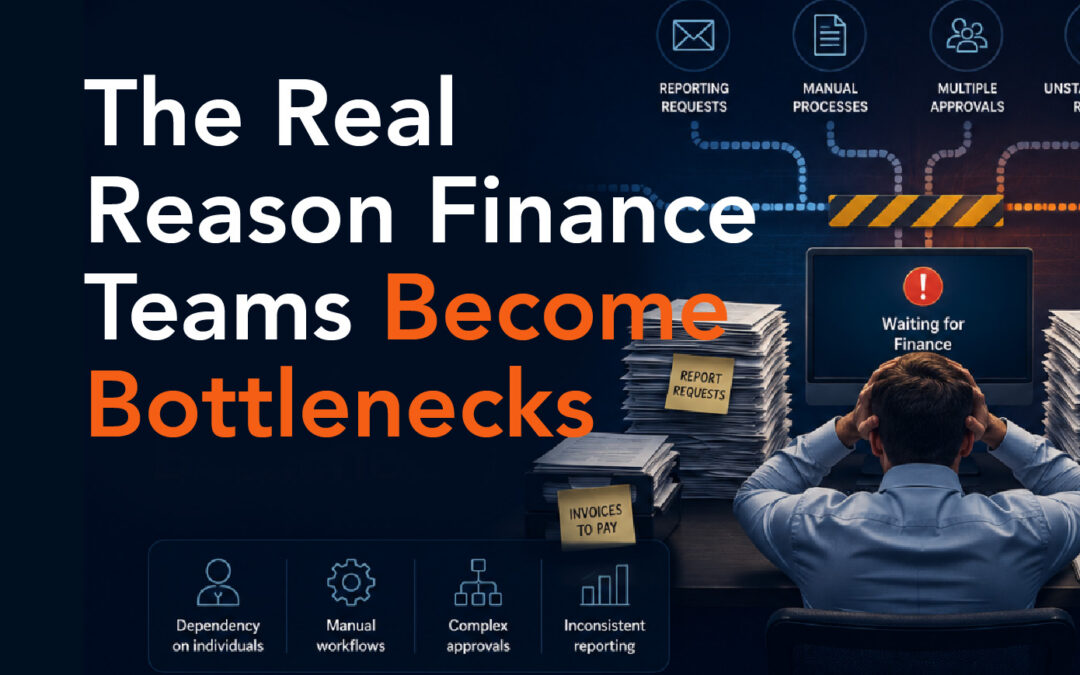
1. Too much knowledge sits with one person
In many businesses, key finance processes rely heavily on individual team members.
One person knows how the reconciliations work. One person controls the reporting spreadsheet. One person understands the month-end process.
This creates dependency, slows down delivery, and increases risk whenever that individual is unavailable.
2. Processes rely on manual intervention
Many finance teams still spend large amounts of time manually moving data between systems, updating spreadsheets, and correcting reports.
As transaction volumes grow, these manual processes become harder to maintain.
Eventually, finance spends more time processing information than analysing it.
3. Approval structures become too complex
As businesses scale, approval workflows often become fragmented.
Invoices wait for sign-off. Payment runs get delayed. Teams chase responses across emails and spreadsheets.
Without clear approval structures, operational finance slows down and creates frustration across the wider business.
4. Reporting processes aren’t standardised
When reports are rebuilt manually every month, finance teams quickly become overloaded.
Different formats. Different calculations. Different data sources.
Without standard reporting structures, even simple reporting requests consume significant time and resource.
Strong finance functions don’t become bottlenecks because they build structure before complexity becomes unmanageable.
Clear workflows. Defined ownership. Consistent reporting processes. Automated routine tasks.
These operational foundations allow finance to support the business efficiently as it grows.
Because the best finance teams don’t slow businesses down.
They create the visibility, control, and structure that allows businesses to move faster with confidence.

Subscribe
Get offers and stay up-to-date
