
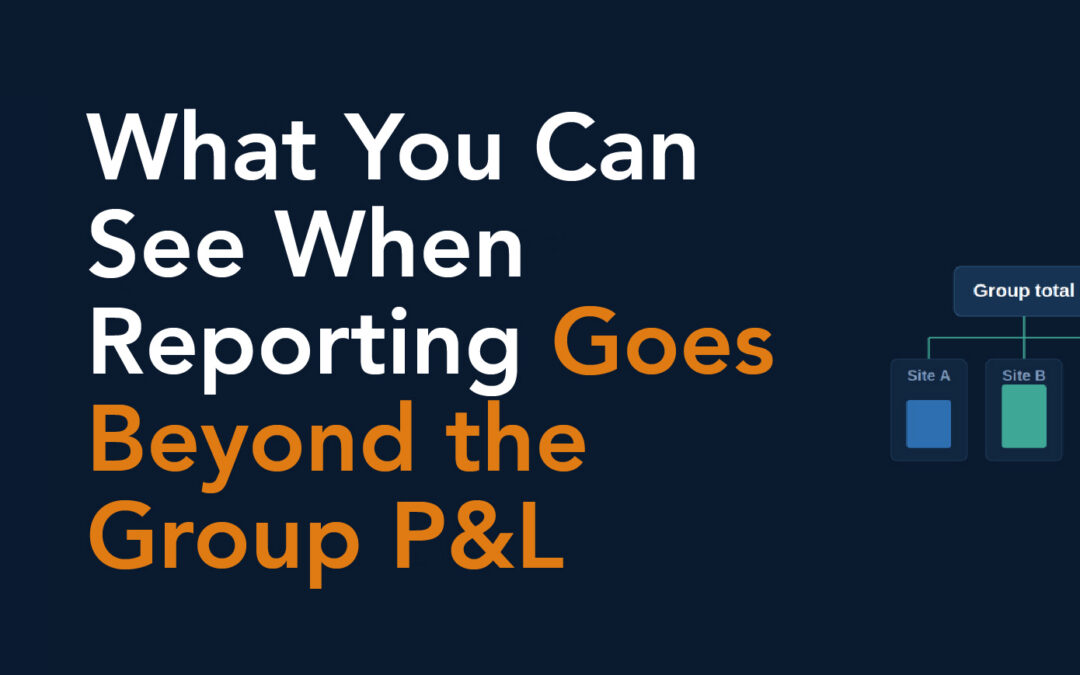
What You Can See When Reporting Goes Beyond the Group P&L
Published: 5th Aug 26
What You Can See When Reporting Goes Beyond the Group P&L
Why aggregate reporting hides the performance that matters most
For many growing businesses, financial reporting stops at the group level.
A consolidated P&L. Total revenue. Overall profit. Group-level costs.
At first, this is usually enough.
But as businesses grow – adding sites, departments, product lines, or entities – group-level reporting starts to hide more than it reveals.
The headline numbers might look healthy.
But underneath the surface, one site could be subsidising another. One department could be quietly losing money. One product line could be carrying the whole business.
And at group level, none of that is visible.
Aggregate reporting answers the question “how did the business do?”
But it rarely answers the more important question: “where, exactly, is performance coming from?”
Here’s what becomes visible when reporting goes beyond the group P&L.
1. You can see which sites or departments actually perform
Site-level and departmental reporting reveals performance that group figures conceal.
Strong areas can be recognised and learned from. Weak areas can be addressed before they affect the wider business.
Without this visibility, leadership is managing the average – not the actual performance underneath it.
2. You can identify where margin is really made or lost
Group profitability is the sum of many different parts, each with its own margin profile.
Breaking reporting down by site, department, or product line shows where margin is genuinely strong and where it’s being eroded.
This is often where the most valuable operational decisions are hiding.
3. You can compare like for like
When performance is reported at a segment level, comparison becomes possible.
Site against site. Department against department. Period against period.
Consistent, comparable reporting turns numbers into a performance tool – showing not just what happened, but how each part of the business measures up.
4. You can give managers ownership of their numbers
When reporting only exists at group level, accountability stays at the top.
Segment-level reporting allows site and department managers to see and own their own performance.
This drives better decisions on the ground – and turns reporting into something the wider business engages with, not just leadership.
5. You can make decisions with the full picture
Leadership decisions are only as good as the visibility behind them.
When reporting goes beyond the group P&L, decisions about investment, resourcing, and focus can be made with a clear view of where performance actually comes from.
That depth of visibility becomes increasingly valuable as the business grows.
Group-level reporting will always have its place.
But as businesses grow, the headline numbers tell an increasingly incomplete story.
The performance that matters most – the strong sites, the weak departments, the margin movements – usually sits beneath the surface.
The strongest finance functions build reporting that can drill into that detail.
Because the businesses that scale best don’t just know how the group performed.
They know exactly where that performance came from – and what to do about it.
Subscribe
Get offers and stay up-to-date
