
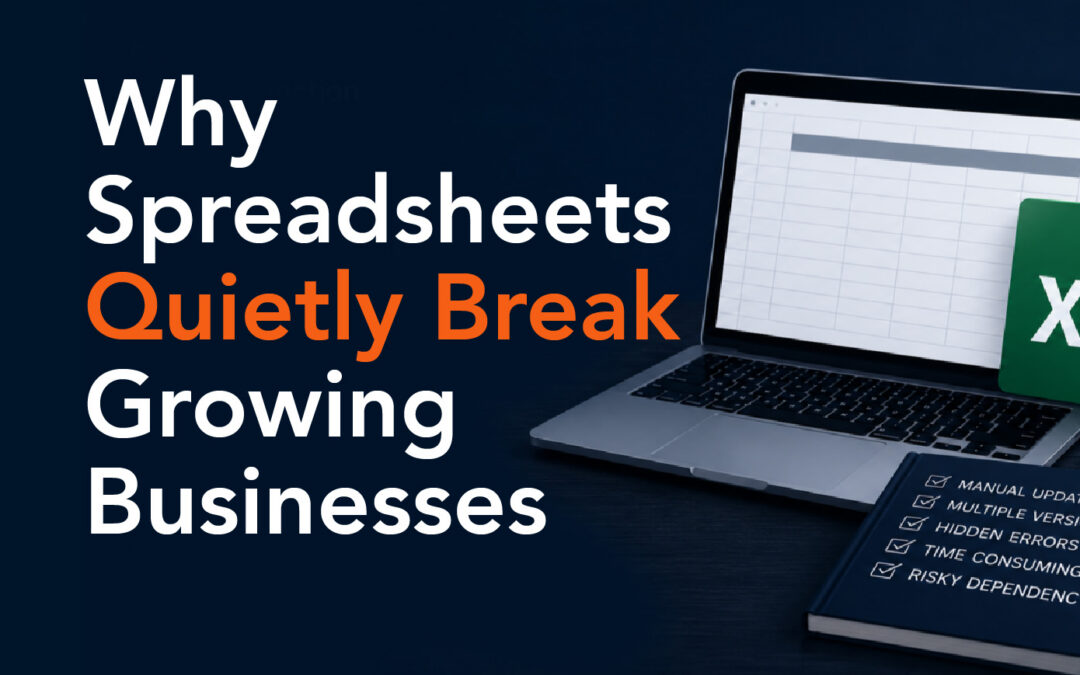
Why Spreadsheets Quietly Break Growing Businesses
Published: 10th Jun 26
Why Spreadsheets Quietly Break Growing Businesses
The hidden operational risks behind manual finance reporting
Spreadsheets are one of the most widely used tools in finance.
And in the early stages of a business, they often work perfectly well.
They’re flexible. Quick to build. Easy to adapt.
But as businesses grow, spreadsheets gradually become something much more dangerous.
They become part of the finance infrastructure.
Many growing businesses don’t notice when this shift happens.
A spreadsheet originally created for a simple analysis slowly evolves into a critical reporting tool.
Then another version appears. And another.
Over time, key reporting processes become dependent on files, formulas, and manual updates that only a handful of people fully understand.
That’s when operational risk starts to build quietly in the background.
Here are some of the most common problems spreadsheet dependency creates inside growing finance functions.
1. Multiple versions of the truth emerge
As reporting becomes more complex, spreadsheets are often copied, edited, and adapted by different people across the business.
Soon there are multiple versions of the same report – each showing slightly different numbers.
Leadership meetings become discussions about which spreadsheet is correct instead of discussions about business performance.
2. Manual reporting creates hidden errors
Spreadsheets rely heavily on manual input.
Copying data. Updating formulas. Moving information between systems.
Even small errors can significantly distort financial reporting, particularly when spreadsheets become linked together across multiple processes.
And because spreadsheets often lack structured controls, those errors can remain hidden for long periods of time.
3. Key finance knowledge becomes concentrated
In many businesses, one person becomes the “owner” of a critical reporting spreadsheet.
Only they fully understand the formulas, adjustments, or reporting logic behind it.
This creates major operational dependency.
If that individual leaves the business or becomes unavailable, reporting continuity can quickly become a serious issue.
4. Reporting becomes slower as complexity increases
What begins as a simple spreadsheet process often becomes increasingly difficult to maintain as transaction volumes grow.
Month-end reporting takes longer. Manual reconciliations increase. Finance teams spend more time preparing numbers than analysing them.
Eventually, the reporting process itself becomes a bottleneck.
Spreadsheets will always have a place in finance.
But they work best as analysis tools – not as the foundation of operational finance infrastructure.
As businesses scale, finance processes need stronger systems, clearer workflows, and more controlled reporting environments.
Because the bigger the business becomes, the more dangerous hidden spreadsheet dependency can be.
The strongest finance functions reduce operational risk by building scalable reporting processes early – before complexity becomes difficult to control.

Subscribe
Get offers and stay up-to-date
